
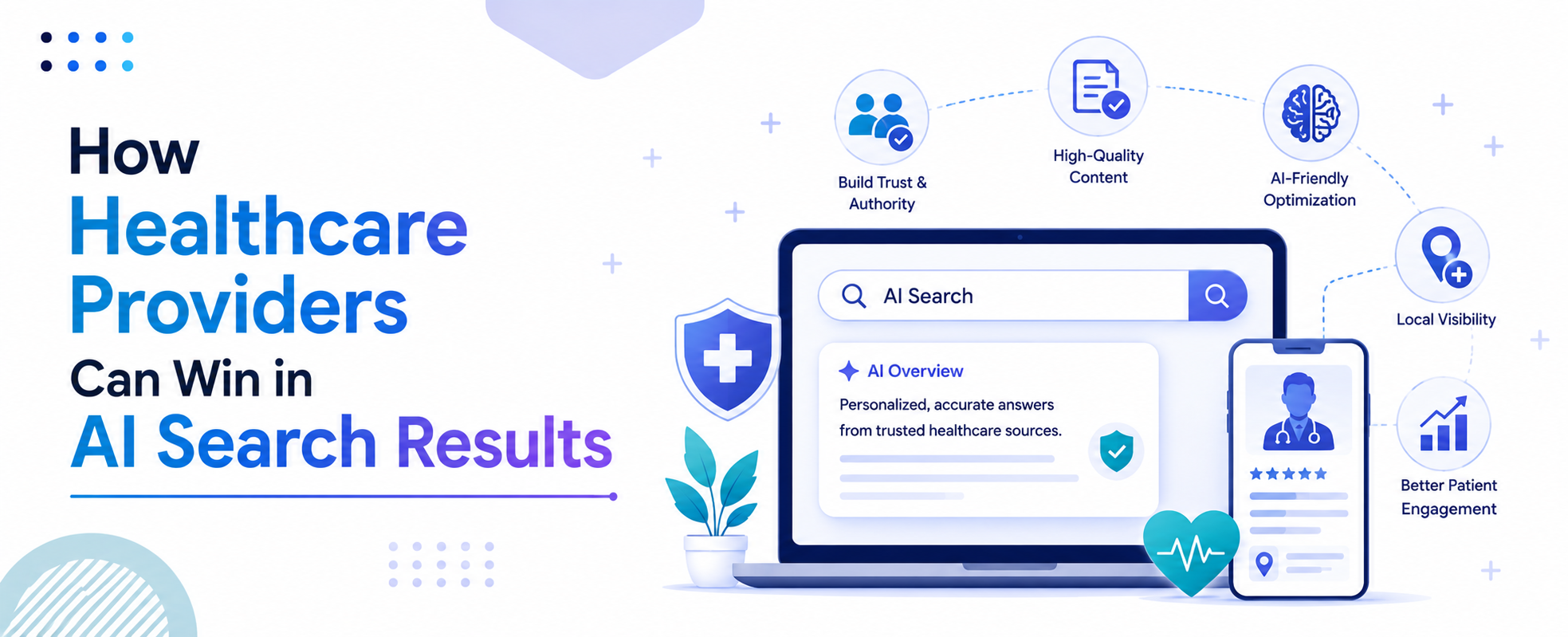
How Healthcare Providers Can Win in AI Search Results
When a patient searches for “best cardiologist near me” or “symptoms of type 2 diabetes,” they are no longer just browsing a list of websites. In 2026, they’re reading an AI-generated answer that synthesizes information from multiple healthcare sources – and the providers cited in those answers are the ones getting the calls, the appointments, and the patients.
Healthcare is one of the most information-heavy and trust-sensitive industries on the internet. This creates both a challenge and a massive opportunity. Providers who invest in AI-search-ready content, E-E-A-T signals, and local authority can dominate patient acquisition in ways that paid advertising alone cannot achieve.
Why the Landscape Is Changing
Google’s Health AI features, Gemini’s medical summaries, and ChatGPT’s healthcare Q&A capabilities are reshaping how patients research symptoms, find providers, and make care decisions. Google’s own data shows that health-related searches have surged, with patients increasingly trusting AI summaries over individual website browsing for initial research.
Simultaneously, Google’s E-E-A-T framework is stricter than ever for YMYL (Your Money or Your Life) content like healthcare. AI engines prioritize content from verified experts, accredited institutions, and providers with clear authorship and credentials.
Key Challenges Healthcare Providers Face
- Generic website content that lacks clinical depth and credibility markers
- No clear authorship – articles not attributed to named, credentialed professionals
- Weak Google Business Profile management leading to poor local search visibility
- HIPAA compliance concerns creating hesitation around digital content strategy
- No structured data for healthcare services, conditions, or physician profiles
Best Practices and Implementation Steps
- Publish condition and treatment pages written by or reviewed by named, credentialed physicians – include author bios with qualifications
- Implement MedicalCondition, Physician, and HealthcareOrganization schema markup
- Optimize Google Business Profile with accurate hours, services, reviews, and Q&A responses
- Build location-specific service pages for every specialty and geography you serve
- Create patient education content in plain language that answers real questions AI engines surface
- Earn citations from medical directories (Healthgrades, Zocdoc, WebMD), hospital network listings, and local news
- Respond professionally to all patient reviews – review engagement is an authority signal
Common Mistakes to Avoid
- Publishing medical content without physician review – this destroys E-E-A-T credibility
- Ignoring local SEO – most patients search within a geographic radius
- Using stock-heavy, impersonal website content that builds no trust
- Not having a mobile-optimized experience – patients search from phones in waiting rooms, pharmacies, and at home
Case Study: Multi-Specialty Clinic Grows New Patient Volume by 45%
A multi-specialty medical clinic partnered with Genexod to overhaul their digital presence. Genexod rebuilt their service pages with physician-authored content, implemented comprehensive medical schema, launched a patient education blog series, and optimized their Google Business Profiles across four locations. In 12 months, the clinic’s new patient volume grew by 45%, their AI search citation rate increased measurably, and their cost-per-acquired patient dropped significantly compared to prior paid ad campaigns.
Future Trends
AI health assistants that recommend specific providers, real-time appointment booking integrated into AI search results, and AI-driven symptom checkers that route patients to appropriate specialists are all on the horizon. Healthcare providers who establish strong digital authority now will be the default recommendations in these systems.
Healthcare providers who invest in AI-search-optimized content, strong E-E-A-T signals, and local authority will win the next decade of patient acquisition. Genexod specializes in healthcare digital marketing that drives real patient growth – compliantly, strategically, and sustainably.