
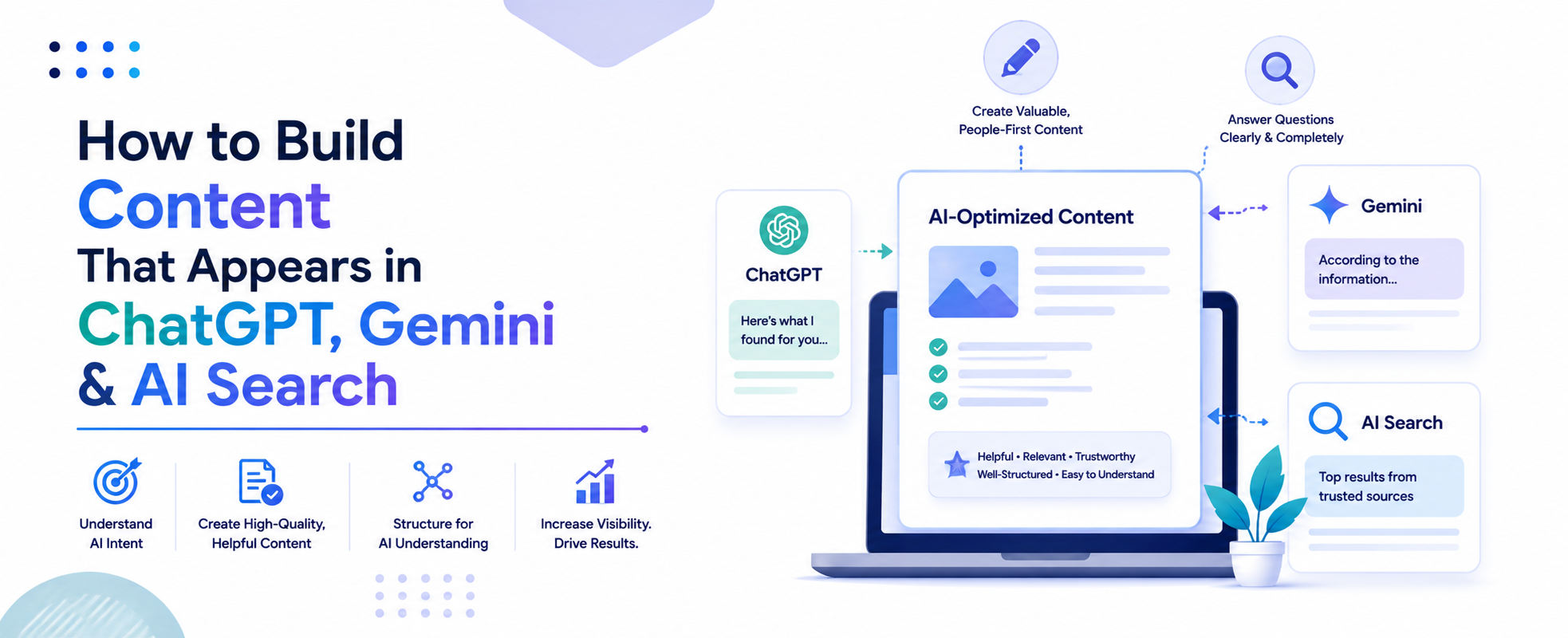
Millions of users are now getting answers from ChatGPT, Google Gemini, Perplexity, and Claude instead of browsing individual websites. These AI systems read vast amounts of web content and synthesize answers – but they don’t cite everyone. They cite authoritative, well-structured, trustworthy sources. If your content isn’t built to be AI-cited, you’re missing the most significant new traffic and authority channel of the decade.
Answer Engine Optimization (AEO) is the content strategy discipline specifically designed to make your brand the source AI engines quote, reference, and recommend. This guide shows you how to build that content.
Why the Landscape Is Changing
The shift from traditional search to AI-generated answers represents a fundamental change in how information is consumed online. ChatGPT alone processes over 100 million queries per day. Google’s AI Overviews appear on a growing share of searches. Perplexity and Claude handle complex research questions that previously drove traffic to multiple websites.
In this environment, being ranked #3 on a search results page is valuable. But being the source that an AI cites when millions of users ask a relevant question is transformative. The brands building AEO-optimized content now are staking their claim in the AI-search era.
Key Challenges Businesses Face
- Content that answers the “what” but not the “why,” “how,” or “when” – AI models prefer comprehensive answers
- Lack of citation-worthy data, statistics, or original research that AI engines prefer to reference
- No clear authorship or expertise signals – AI models weight content from named experts heavily
- Poor content structure – AI prefers logically organized content with clear headings and definitions
- No presence in the external databases and knowledge sources AI models draw from
Best Practices and Implementation Steps
- Write in “definition-first” format: answer the question directly in the first sentence or paragraph, then elaborate
- Create FAQ sections for every major piece of content – AI models heavily favor Q&A formatted content
- Produce original research, surveys, or data studies – being a primary source dramatically increases citation potential
- Use named, credentialed authors and include author bios – AI models weight expert authorship
- Structure content with logical H2 and H3 headings that map to predictable query patterns
- Maintain topical consistency – become the authoritative source for a specific topic cluster rather than covering random subjects
- Ensure fast page load speeds and mobile responsiveness – AI scrapers deprioritize slow or broken pages
- Earn backlinks from authoritative sources – external validation increases the probability of AI citation
Common Mistakes to Avoid
- Writing for length rather than depth – 2,000 words of surface-level content won’t be cited; 800 words of precise, comprehensive information might be
- Avoiding clear, direct answers out of caution – AI models reward content that commits to answers
- Publishing content without structured markup – schema and formatting are the language of AI comprehension
- Ignoring niche platforms – Perplexity, Claude, and newer AI tools often cite from sources that traditional SEO overlooks
Case Study: B2B Technology Company Cited in Gemini and Perplexity
A B2B technology consulting firm worked with Genexod to restructure their blog content for AEO. Genexod rewrote 15 high-priority articles in definition-first, FAQ-rich formats, added expert author profiles, and implemented FAQ schema. Within five months, the firm’s content began appearing as cited sources in Google Gemini’s AI Overviews and Perplexity answers for their core service queries. Branded search volume grew by 42%, and inbound consultation requests attributed to AI-search increased significantly.
Future Trends
As AI models become more capable of real-time web browsing and synthesis, content freshness will become increasingly important. Brands that maintain consistently updated, original, expert-driven content libraries will achieve compounding AI citation rates. Video and audio content will also increasingly be indexed and cited by next-generation AI engines.
Conclusion
The content strategies that worked in 2019 are table stakes today. In 2026 and beyond, the brands that win are those whose content AI engines trust enough to cite. Building that trust requires structure, expertise, originality, and authority – all of which Genexod helps brands develop systematically.
