
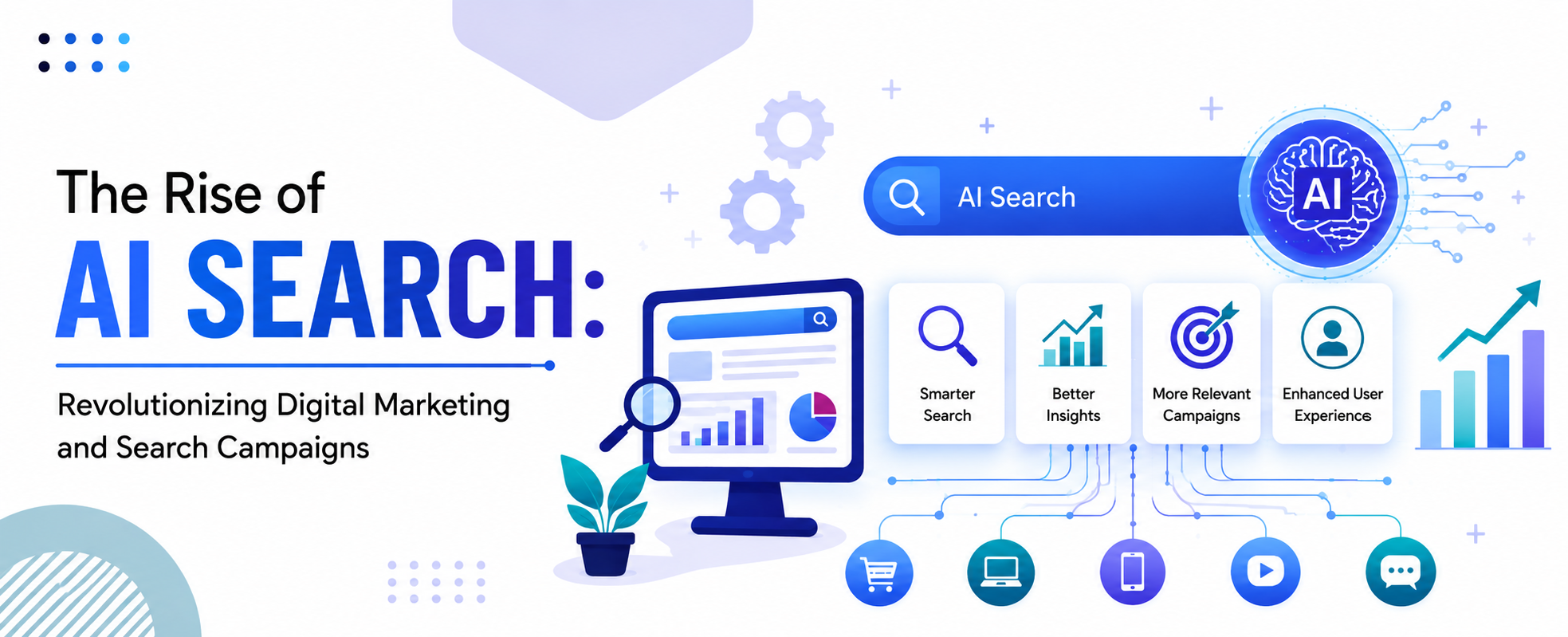
The AI Search Revolution: Why Your Digital Marketing Strategy Must Evolve or Be Left Behind
For years, digital marketing has played by a set of predictable rules. We chase keywords, build landing pages, and optimize for a list of ten blue links. But that rulebook is being rewritten in real-time. The future of search is no longer just about matching text; it’s about understanding intent. It’s intelligent, deeply personalized, and powered by artificial intelligence—and your strategy must be too.
This isn’t just another algorithm update. This is a seismic shift. Platforms like Google’s Search Generative Experience (SGE) and Microsoft Copilot are transforming search from a simple Q&A into a rich, conversational dialogue. Businesses that understand the power of AI for Digital Marketing will gain a massive competitive edge in this new landscape.
So, what does this mean for your search campaigns, and how can you leverage this new landscape for growth?
The Impact: How AI Search Changes Everything
The fundamental difference between traditional and AI search lies in the journey from a question to an answer.
- Traditional Search: A user types keywords (“best CRM for small business“). The engine returns a list of websites it believes are relevant. The user must then click through these links, read the content, and synthesize their own answer. The goal is to find a relevant source.
- AI Search: A user asks a conversational question (“I need a CRM for my 5-person sales team that integrates with QuickBooks and is under $50/month per user”). The AI synthesizes information from multiple top-ranking sources and provides a direct, summarized answer right on the results page. The goal is to get a complete answer.
This shift has profound impacts:
- The “Zero-Click” Search Becomes the Norm: If a user gets their answer directly in the AI-generated snapshot, they have less reason to click through to your website. Traffic from informational, top-of-funnel queries may decline.
- Conversational Queries Dominate: Simple keywords are being replaced by complex, natural language questions. AI understands nuance, context, and follow-up questions.
- Authority and Trust are Paramount: AI models are designed to pull information from the most authoritative and trustworthy sources. Being a “good enough” source is no longer sufficient. You must be an undisputed expert.
If your brand wants to thrive, it must embrace AI for Digital Marketing to optimize not only for rankings but for how AI interprets, summarizes, and showcases your content.
Growing Your Search Campaigns on AI-Based Platforms: The New Playbook
Clinging to old keyword-stuffing tactics is a recipe for failure. Growth in the AI era requires a strategic pivot from gaming an algorithm to genuinely serving user intent.
- Go Beyond Keywords to Master Intent
Your new focus isn’t on a single keyword, but on the entire ecosystem of questions a user might have.
- Old Way: Targeting the keyword “Performance Max.”
- New Way: Creating a content cluster that answers:
- What is Performance Max and how does it work?
- How do I set up my first PMax campaign?
- What are the best practices for PMax asset groups?
- How do I analyze PMax reporting to improve ROI?
When you comprehensively answer the entire topic, you signal to AI that you are the definitive source.
- Optimize to Be a “Featured Source”
Since the AI snapshot is the new “position zero,” your goal is to have your content cited within it. This means making your content easily digestible for AI.
- Use Structured Data (Schema Markup): Explicitly tell search engines what your content is about (e.g., this is a product, this is a review, this is a how-to guide). This is a direct line of communication to the AI.
- Create “Snippet-able” Content: Use clear headings, bullet points, numbered lists, and provide concise, direct answers. Make it effortless for the AI to pull your sentence or paragraph into its summary.
- Embrace E-E-A-T (Experience, Expertise, Authoritativeness, Trustworthiness)
Google’s quality guidelines are now the blueprint for AI search optimization.
- Demonstrate First-Hand Experience: Show, don’t just tell. Use case studies, original data, and real-world examples.
- Showcase Expertise: Feature author bios, credentials, and link to authoritative sources.
- Build Authority: Earn backlinks from other respected sites in your industry and create comprehensive, pillar content.
- Leverage AI-Powered Advertising Platforms
The most significant opportunity for growth lies in platforms already integrating AI for Digital Marketing.
- Google Performance Max (PMax): This is the ultimate AI-driven campaign type. You no longer manage bids on individual keywords. Instead, you provide Google with assets (headlines, images, videos, audience signals) and a business goal (e.g., maximize conversions). The AI then automates targeting, bidding, and ad delivery across all of Google’s channels (Search, YouTube, Display, etc.) to find the most profitable customers. Success on Google Ads now depends on your ability to feed the AI high-quality creative and strategic signals.
- Microsoft Advertising (and Copilot): Similarly, Microsoft’s ad platform uses AI for automated bidding and audience targeting. With Copilot integrated into Bing, optimizing your content for conversational queries makes you more visible to a growing user base that relies on AI for answers.
The Bottom Line
The future of search is a dynamic conversation, not a static list of links. The brands that win won’t be those chasing algorithms but those mastering AI for Digital Marketing to build real authority and engagement.
Your strategy must reflect this. Stop chasing keywords and start answering questions. Stop building thin landing pages and start building deep libraries of expert content. And most importantly, learn to collaborate with AI-powered ad platforms by providing them with the strategic goals and creative assets they need to drive growth.
The revolution is here. The brands that adapt will not just survive; they will define the future of digital marketing.
